The evidence
Does red light therapy work for hair loss?
For pattern hair loss, the pooled trials find more hair than with a sham device. They do not say every cap works, and they do not say anyone is cured.
We compare hats using manufacturers’ published specs, prices and the clinical research, and we don’t earn commission on links. How we review.
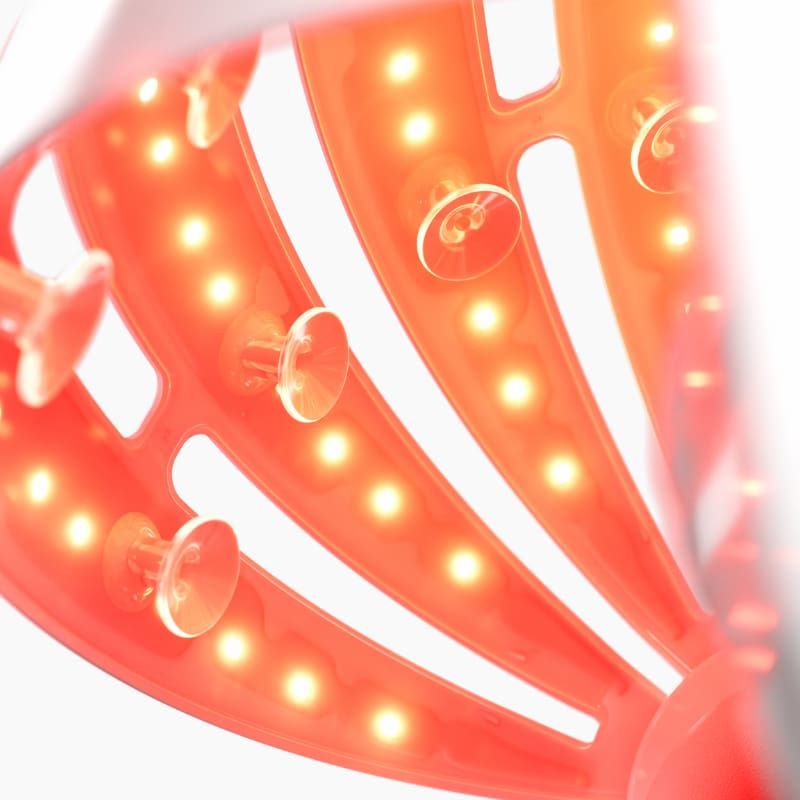
For pattern hair loss, yes on average: sham-controlled trials and meta-analyses find more hair with low-level red light or laser than with a sham device. The stronger studies count hairs at about 16 to 26 weeks, and they do not all agree on the size of the change. Those trials were not run on the four shop models in this guide, and they are not a cure.
On this page
On this page
For pattern hair loss, yes, on average. Randomised trials that compared low-level red laser or LED devices with a sham device have found more hairs in a measured patch of scalp. The average hides people who did not respond. The trials disagree about the size of the change. They were not run on most of the caps now sold in Britain, and they barely exist for other kinds of hair loss.
If the shedding is sudden, patchy, or comes with illness, see a GP before you spend money on a device. That is the NHS advice, and it comes before any hat.
What did the 2019 Liu meta-analysis find?
Liu and colleagues, in Lasers in Medical Science, pooled randomised sham-controlled trials of low-level laser therapy for androgenetic alopecia. Eight studies contained 11 randomised comparisons. Hair density rose more with the devices than with sham. The standardised mean difference was 1.316, with a 95% confidence interval of 0.993 to 1.639.
The increase showed up in men and in women, with comb-type devices and with helmet-type devices. Trials that treated less often had a larger effect than trials that treated more often, which is a useful warning against assuming that daily is always better. The authors also warned that the trials were heterogeneous: they do not agree with each other very well.
What did the photobiomodulation meta-analysis find?
A meta-analysis in the Journal of Dermatological Treatment (PubMed 31746251) looked at photobiomodulation and hair density across 15 studies and 795 people. The standardised mean difference was 1.02 (0.68 to 1.36) in favour of treatment. Comb versus helmet or hat was not significant (p = 0.08). Laser versus a combination of laser and LED did differ: laser looked more effective (p = 0.009), and the combination was still better than control. That is not “LED does not work”.
What did Perez and colleagues find?
Perez, Vattigunta, Kelly and Eber, in Dermatologic Surgery (PubMed 39404126), pooled 38 studies and 3,098 patients, 2,930 of them with androgenetic alopecia. Hair density was higher than placebo. The standardised mean difference was 1.14 in studies shorter than 20 weeks and 1.44 in studies longer than 20 weeks. Heterogeneity was high. They did not have enough data to make the same claim for other alopecias.
The longer studies had the larger average difference. Brand pages that say 12 weeks, 16 weeks or 90 days are in the right season if they mean “do not judge it next weekend”. They overclaim if they mean most people will see a clear change by then. RedLight Innovation talks about a 90-day challenge. Ninety days is about 13 weeks, which is on the early side of that window. Beauty Pie’s footnote says 12 to 24 weeks.
What do these hair-loss trials not show?
They do not cover a guarantee for the Hat Pro or for anyone else’s device. Matching a studied wavelength is the minimum for borrowing these results. Matching the device, the dose and the schedule is the honest version, and almost no shop page does it. Blue light at 450 nm, which the Hat Pro includes, is not the intervention these meta-analyses pooled.
It does not cover alopecia areata, scarring, or shedding after illness, childbirth or chemotherapy, beyond the statement that the big review did not have the data.
It does not say red light is risk-free over decades. The trials are months long. Manufacturers still list redness and headache. That is the side-effects page. How light compares with minoxidil is a separate question, with its own trial: red light or minoxidil.
There is no good evidence here for a universal early shed that “proves it is working”. Shedding happens in pattern hair loss anyway. A sudden or patchy shed is a reason to talk to a GP.
When did the studies measure a change?
The stronger sham-controlled trials counted hairs at about 16 to 26 weeks. Brand pages cite 84 days, 90 days, or 12 to 24 weeks.
- 84 days
CurrentBody’s 31-person study measured out to 84 days. The summary does not describe a sham helmet.
- 90 days
RedLight Innovation’s challenge is about 13 weeks, on the early side of the longer trials. Its own feature follows six people.
- 12–24 weeks
Beauty Pie’s footnote puts the studies it cites in this range. The brand says those studies were not of this cap.
- 16–26 weeks
The stronger sham-controlled trials counted hairs over a few months, not over a weekend.
- After 20 weeks
Perez and colleagues found a larger average difference in studies longer than 20 weeks (SMD 1.44) than in shorter ones (SMD 1.14).
- 6 months
A 2024 trial compared a 633 nm light protocol with 5% minoxidil in men. Both groups gained density. The difference between them was not significant.
Common questions
Does red light therapy regrow hair?
In pattern hair loss, meta-analyses of sham-controlled trials report a higher average hair density with low-level laser or LED light than with sham. That is an average change over several months. It is not a cure, and it is not a result for every person or every device.
How long before the studies measured anything?
Often 16 to 26 weeks. One large review found a bigger average difference after more than 20 weeks than in shorter studies. A change at three weeks is not what these trials were built to show.
Does it work for alopecia areata or shedding after illness?
The big reviews did not have enough comparable data. Almost all of the patients had pattern hair loss. Other diagnoses need their own evidence.
Are the UK hats the devices from the trials?
Usually not. The trials used particular combs, helmets and panels. A shop cap that cites those trials is citing the category, unless it names a study that used that cap.
Sources
- Liu and colleagues, 2019, Lasers in Medical Science — Eight studies, 11 randomised trials, sham-controlled. SMD 1.316 for hair density.
- Perez and colleagues, Dermatologic Surgery — 38 studies, 3,098 people. Density gains in androgenetic alopecia.
- Meta-analysis of photobiomodulation, Journal of Dermatological Treatment — 15 studies, 795 people. SMD 1.02.
- 2024 trial versus 5% minoxidil
- NHS: Hair loss