The evidence
Red light therapy for hair loss
A cap or a helmet, a few minutes a day, sold on the idea that red light helps thinning hair. Here is what that actually means in the UK.
We compare hats using manufacturers’ published specs, prices and the clinical research, and we don’t earn commission on links. How we review.
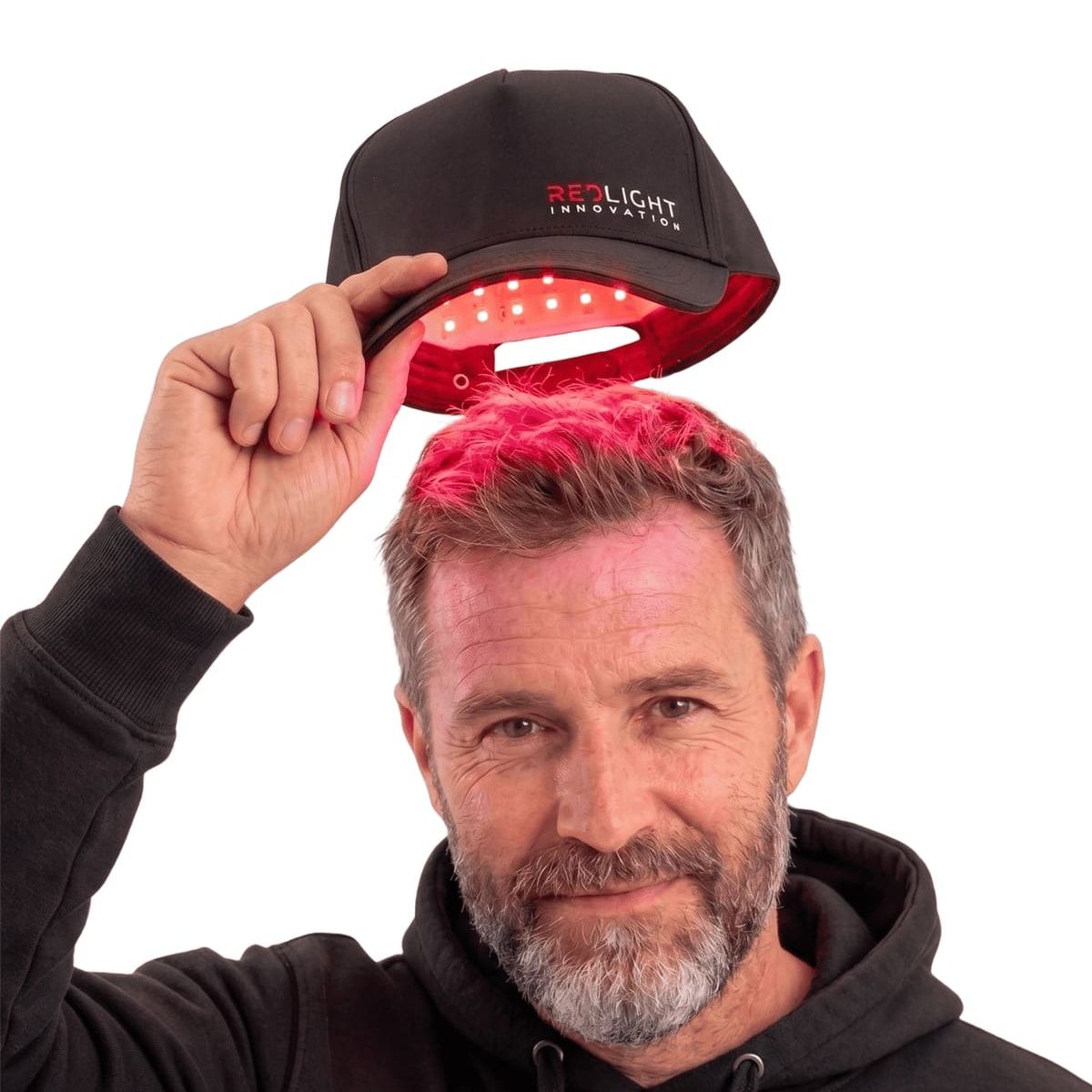
Red light therapy for hair loss is a home cap or helmet worn for 10 or 15 minutes a day. In pattern hair loss, pooled trials find more hair on average with low-level red light or laser than with a sham device, usually over 16 to 26 weeks. Home caps are not an NHS treatment, and our best overall on published price, fit and coverage is the Hat Pro at £372.
On this page
On this page
Red light therapy for hair is a home device, usually a cap or a helmet, worn for a few minutes a day. In the UK it sits next to minoxidil, private clinics and a lot of confident marketing. This page is the map. The arguments have their own pages, because a single scrolling advert is how this subject usually goes wrong.
What is red light therapy for hair?
The light is red, typically somewhere between about 630 and 680 nanometres, sometimes joined on a product page by blue. At these wavelengths it is not ultraviolet. It does not tan the skin, and it is not the “light treatment” the NHS describes, which is ultraviolet light on bald patches.
The idea, called photobiomodulation or low-level light therapy, is that the light is absorbed in tissue and changes how cells behave. You do not need the idea to read the trials. The trials either counted more hairs or they did not.
Devices come as combs, caps, helmets and salon lamps. The light source is either a laser diode, a narrow beam, or an LED, a wider spread. Both appear in the research. “Laser means medical, LED means a toy” is dealt with on LED or laser.
Who has red light therapy for hair been studied in?
Almost all of the people in the big reviews had androgenetic alopecia: pattern hair loss. Perez and colleagues, pooling laser and LED studies, found 2,930 of 3,098 patients were in that group. For alopecia areata, scarring, telogen effluvium and hair loss after chemotherapy, they found a handful of studies and not enough comparable numbers to pool.
Pattern hair loss is common, often familial, and the NHS describes it as something that does not simply reverse, even though treatments can thicken what remains while you use them. A shed after a fever, a diet, a birth or a new medicine is often a different process. Patchy bald coins can be alopecia areata. Buying a cap because the words “hair loss” match the box is how people spend £400 on the wrong problem. If you are worried, see a GP before a commercial clinic.
What results do the trials show?
The evidence page has the figures. Sham-controlled trials, pooled, find more hair per square centimetre with the light than with a device that does not emit it. The difference is an average, including people who did not respond. Follow-up in the better studies is measured in months. The studies do not agree on the size of the effect.
Device pages often turn this into “clinically proven” and a percentage from their own photographs. Sometimes that percentage is a commissioned before-and-after with no sham device. Sometimes it is a survey. Sometimes the footnote admits the device you are buying was not the one in the study. The buying guide is how to tell those apart.
Which red light hats are on sale in the UK?
Our comparison looks at four devices. Beauty Pie’s cap is £332 and was out of stock. The RedLight Innovation Hat Pro is £372, and it is the best overall: a stated fit, about 80% coverage, and red wavelengths in the research range. HigherDOSE’s hat is £449. CurrentBody’s helmet is £649.99 and was out of stock. All four are red LEDs. None of those pages listed near-infrared. Sessions are 10 or 15 minutes.
The device-specific evidence runs from Beauty Pie’s note that its cap was not independently tested, through HigherDOSE’s user survey and RedLight Innovation’s six-person series, to CurrentBody’s 31-person study summary, which does not describe a sham helmet. The category trials are stronger than any of those, and they do not certify a 2026 shop model.
How does red light therapy compare with hair-loss medicines?
Finasteride and minoxidil are the main NHS-named treatments for male pattern hair loss. Minoxidil can be used for female pattern hair loss. Women should not use finasteride. They do not work for everyone, and only while you use them. A 2024 trial found a 633 nm light protocol and 5% minoxidil produced similar density increases in men over six months. A separate trial of a laser comb added to minoxidil did not find a significant extra gain. The comparison is red light or minoxidil.
Home caps are not an NHS treatment. What the marks on the box mean, and what FDA clearance does not mean, is on the regulation page. Redness, headache and shedding are on the side-effects page.
Common questions
Does red light therapy work for hair loss?
In pattern hair loss, trials and meta-analyses find a higher average hair density with low-level red light or laser than with a sham device, usually over 16 to 26 weeks. It is an average, not a promise, and it has not been shown the same way for other kinds of hair loss.
Is it available on the NHS?
No. You buy a hat yourself. The NHS names minoxidil and, for men, finasteride as the main treatments for pattern hair loss, and says they do not work for everyone.
How often do people use a hat?
The devices in our guide say 10 or 15 minutes a day. Trials have also used three times a week. Consistency over months matters more than a heroic first week.
Which hat should I buy?
The RedLight Innovation Hat Pro, at £372, is our best overall. The full comparison is on the homepage.