Buying guide
How to choose a red light therapy hat
Five checks before you spend a few hundred pounds: wavelength, dose, coverage, fit, and the kind of proof on the page.
We compare hats using manufacturers’ published specs, prices and the clinical research, and we don’t earn commission on links. How we review.
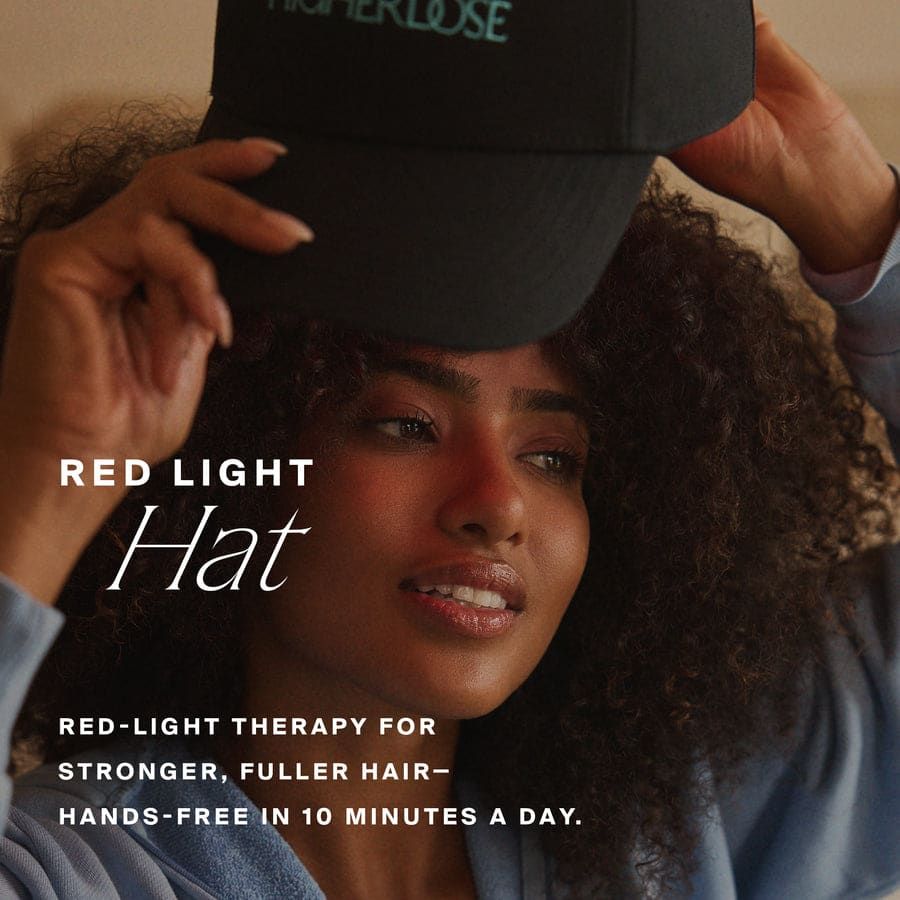
Choose a red light therapy hat by the wavelength, the dose, the coverage, the fit and the kind of proof on the page, not by the slogan. Hair-density trials most often use red light around 630–680 nm. A price only counts in this guide if it is on the brand’s own page.
On this page
On this page
The listing pages collapse a hat into one adjective: clinical, medical-grade, FDA-cleared, full coverage. None of those is a specification. This is the checklist behind the UK comparison.
What kind of hair loss are these hats for?
These devices are marketed at pattern thinning: a widening part, a thinning crown, a hairline that matches the family. That is androgenetic alopecia, and it is what the density trials studied.
They were not trials of shedding after illness, of alopecia areata, of scarring, or of hair loss that needs a blood test. The NHS says it is normal to lose 50 to 100 hairs a day, that pattern baldness is often permanent and often familial, and that other loss can follow illness, stress, cancer treatment, weight loss or iron deficiency. See a GP if you are worried, before you buy.
If a GP has already called it pattern hair loss, the NHS discusses minoxidil and, for men, finasteride. A hat does not retire that conversation. The comparison is here.
What wavelength should a red light hat use?
Hair-count studies most often use red light, commonly around 630–680 nm. If a listing names no wavelength, skip it.
Hair-count studies most often use red light, commonly around 630–680 nm. You will see 633, 650 and 655 nm in individual trials. A hat that states 650 nm, 655 nm, or a band such as 620–660 nm is at least speaking that language.
Three wavelengths are not automatically better than one. A trial uses the wavelength it uses. Extra wavelengths are a hypothesis. RedLight Innovation’s hat lists 615, 635 and 650 nm. The two longer ones overlap the research band. The extra one does not, by itself, make a result.
Blue light, such as the Hat Pro’s 450 nm channel, is usually a scalp-surface claim. Near-infrared, often 800 nm and above, is a different claim again. None of the four UK pages listed near-infrared. If a listing says “red and near-infrared” and the spec block does not name the nanometres, believe the block.
How do you judge the dose of a red light hat?
Irradiance is milliwatts per square centimetre. Total power is milliwatts for the whole panel. They answer different questions.
A useful shortcut, using the manufacturer’s figure:
joules/cm² = mW/cm² × minutes × 0.06
- 5 mW/cm² for 10 minutes is about 3 J/cm². That is HigherDOSE’s stated density and time.
- 10 mW/cm² for 15 minutes is about 9 J/cm². The 10 mW/cm² figure is on a RedLight Innovation page other than the main product listing, which itself says 500 mW for the panel.
- Beauty Pie states 20 mW/cm² at the device surface, for 10 minutes. The brand says a higher optical figure is not a better clinical result.
- CurrentBody does not state irradiance, so there is nothing honest to multiply.
Do not divide 500 mW by a guessed area and call it a density.
How much of the scalp does a red light hat cover, and will it fit?
Coverage is how much of the scalp gets the light in one session. Measure your head before you care about the wavelength. RedLight Innovation’s product page says about 80%. Other pages on that site say 360° and full scalp. Use 80%. Eighty percent still leaves the hairline and temples as the usual gap on a cap.
CurrentBody describes a full-head helmet and gives sizes instead of a percentage: medium 54–58.9 cm, large 59–63.5 cm. HigherDOSE says flexible sizing. Beauty Pie does not state a size. Measure before you care about the wavelength.
What kind of evidence is on the box?
Put the brand’s proof in one of these buckets, and do not let the headline upgrade it. A sham-controlled trial, a medicine comparison, an uncontrolled series, a user survey and a citation of someone else’s device are not the same kind of proof.
- A sham-controlled trial of this device, or a fair summary of the category trials.
- A trial against a medicine, which may or may not show an extra gain.
- An uncontrolled series. CurrentBody’s 31-person summary and RedLight Innovation’s six-person feature live here.
- A user survey. HigherDOSE’s 28 people live here.
- A citation of someone else’s device. Beauty Pie’s footnote says this outright.
“FDA-cleared” is a US status. It is not an MHRA decision and it does not put a hat on the NHS. The marks are explained on the regulation page.
What routine will you actually keep?
The winning routine in the research is the one people still follow at month four. Ten or fifteen minutes is manageable. A helmet you will not wear is a worse buy than a cap you will. Judge a shed in the first weeks as something to notice, not as proof the device is “waking follicles up”. More on that is on the safety page.
Common questions
What wavelength should a hair hat use?
Red, often around 630–680 nm. That is the range that shows up in the hair-density trials. Blue and near-infrared are different claims. If a listing names no wavelength, skip it.
Is a higher milliwatt number better?
Only if it is the same kind of number. Milliwatts for the whole panel are not milliwatts per square centimetre at the scalp. More light is not automatically a better dose.
How do I turn a session into a dose?
Multiply mW/cm² by the minutes, then by 0.06, to get joules per square centimetre. Ten minutes at 5 mW/cm² is about 3 J/cm². Fifteen minutes at 10 mW/cm² is about 9 J/cm². Use the manufacturer’s figure.
Does the hat need a UKCA mark?
If it is sold as a medical device, it needs a legal route onto the Great Britain market. That can be UKCA or, for a transition period, a CE mark under the rules on GOV.UK. A cosmetic cap is presented differently. FDA clearance is the US answer, not the UK one.
Sources
- Liu and colleagues, 2019 meta-analysis
- Perez and colleagues, systematic review
- GOV.UK: regulating medical devices
- NHS: Hair loss
- RedLight Hat Pro product page — An example of a total power figure and a separate irradiance figure.